
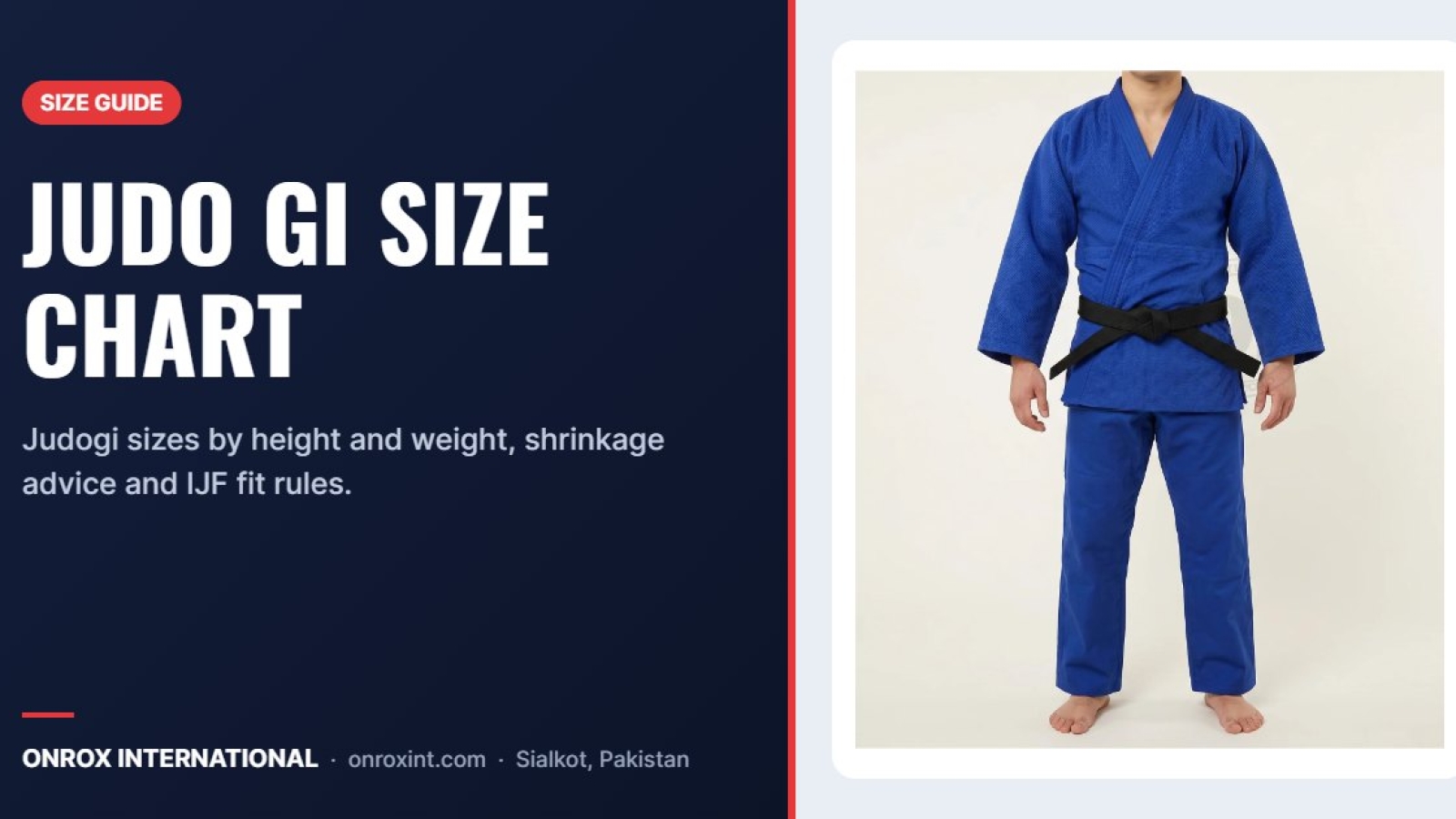
Short answer: most judo gis (judogi) are sized by height in centimetres. A size 170 fits someone around 165–175 cm tall, a size 180 fits 175–185 cm, and so on. Choose the size closest to your height, then size up if you are heavily built or between sizes. Cotton judogi can shrink a few centimetres in the first washes unless the fabric is pre-shrunk. For competition, the jacket must also pass the fit checks in the IJF judogi rules.
This guide gives you a judo gi size chart for adults and kids, explains how to measure, summarises the IJF fit rules, and shows clubs and brands what to specify when ordering custom judo gis.
How Judo Gi Sizes Work
There are two common sizing systems:
- Height sizes (cm): 110, 120, 130 … 200. The number is the wearer’s height. This is the most common system and the one we use.
- Number sizes (0000–7): used by some older and Japanese-style brands. A size 3 or 4 typically fits an average adult man, but the conversion varies between brands, so always check the brand’s own chart.
Some brands also offer slim (S) and wide (W) versions of each height, for example 180S or 180W.
How to Measure for a Judo Gi
- Height: stand straight against a wall, no shoes.
- Weight: use your current weight.
- Chest: around the fullest part, under the arms.
- Arm length: from the back of the neck, over the shoulder, to the wrist, with the arm straight out in front.
Height chooses the size. Weight and chest tell you whether to go up a size or choose a wide cut.
Adult Judo Gi Size Chart
| Size | Height (cm) | Height (ft/in) | Weight (kg) |
|---|---|---|---|
| 150 | 145–155 | 4’9″–5’1″ | 40–50 |
| 160 | 155–165 | 5’1″–5’5″ | 50–60 |
| 170 | 165–175 | 5’5″–5’9″ | 60–72 |
| 180 | 175–185 | 5’9″–6’1″ | 70–85 |
| 190 | 185–195 | 6’1″–6’5″ | 85–100 |
| 200 | 195–205 | 6’5″–6’9″ | 95–115 |
This is a typical starting chart. If your weight is above the range for your height, go up one size or choose a wide cut.
Kids’ Judo Gi Size Chart
| Size | Height (cm) | Age (approx.) | Weight (kg) |
|---|---|---|---|
| 110 | 105–115 | 4–5 | 17–21 |
| 120 | 115–125 | 6–7 | 21–26 |
| 130 | 125–135 | 8–9 | 26–31 |
| 140 | 135–145 | 10–11 | 31–40 |
Children grow quickly, so most clubs and parents order one size up for kids’ judogi.
Shrinkage: Pre-Shrunk vs Not
Cotton shrinks when washed hot or tumble dried. A judogi that is not pre-shrunk can lose around 3–5% in length over the first washes, which on a size 180 jacket sleeve can mean several centimetres.
- Pre-shrunk judogi: buy your normal size.
- Not pre-shrunk: buy one size up, wash cold and air dry.
- Competition judogi: buy the size that fits after washing, because fit is checked at the event.
IJF Judogi Fit Rules (Summary)
At IJF events, judogi are checked for fit before the contest. The main measurable points in the IJF judogi rules (2018 version) are:
| Part | IJF requirement |
|---|---|
| Jacket skirt | Must completely cover the buttocks |
| Sleeves | Must cover the full arm, including the wrist, in the control position; a measuring tool (sokuteiki) must slide fully inside the sleeve |
| Lapels | Maximum 1 cm thick and 4 cm wide |
| Jacket overlap | Crossed lapels must overlap by at least 20 cm at belt level |
| Trousers | Must end no more than 5 cm above the ankle bone |
| Trouser width | 10–15 cm between leg and trouser at knee level |
| Belt | 20–30 cm of belt left on each side of the knot |
| Colours | White, or blue between Pantone 286M and 285M |
| Back number | Top edge 3 cm below the collar |
IJF competitions also require IJF-approved judogi with the official IJF label, which only IJF-licensed manufacturers can supply. Rules are updated from time to time, so check the current IJF judogi rules and your national federation’s rules before buying for competition.
For club training and most national and regional events, a well-fitting single or double weave judogi made to the same cut is what matters.
Single Weave vs Double Weave: Which to Choose
| Single weave | Double weave | |
|---|---|---|
| Weight | Around 450–550 GSM | Around 600–750 GSM |
| Feel | Lighter, cooler, softer | Heavy, stiff, hard to grip |
| Price | Lower | Higher |
| Best for | Beginners, kids, club training | Competition, regular training, grading |
| Size advice | Normal size | Normal size; heavier fabric shrinks less if pre-shrunk |
Our guide to judo gi manufacturing in Pakistan explains weaves and weights in more detail.
Judo Gi Specs for Clubs and Brands
When a club or brand orders custom judogi from a factory, the size chart is only one page of the brief. These are the specs to send, with our standard at Onrox International:
| Spec | What to specify | Onrox standard |
|---|---|---|
| Jacket weave | Single, double or gold weave | All three available |
| Jacket weight | GSM | Single 450–550 GSM, double 600–750 GSM |
| Trousers | Fabric and weight | Cotton or poly-cotton, specified per order |
| Colour | White or blue | White and blue |
| Pre-shrinking | Yes or no | Agreed per order |
| Cut | Regular, slim or wide | Made to your size chart |
| Branding | Embroidery positions | Club name, flag, back name and logo embroidery |
| MOQ | Pieces per design | 25 pieces |
Note: Onrox makes competition-cut judogi for clubs, federations and brands. Official IJF events need judogi carrying the IJF label from IJF-licensed manufacturers.
Garment Measurement Points for a Judogi Tech Pack
| Point of measure | How it is measured |
|---|---|
| Jacket length | High point of shoulder to hem, centre back |
| Chest width | Armpit to armpit, laid flat |
| Sleeve length | Centre back neck to cuff |
| Sleeve width | At armpit and at cuff, laid flat |
| Lapel width and thickness | At centre front |
| Trouser length (outseam) | Waist to hem |
| Trouser leg width | At knee and at hem, laid flat |
Add a tolerance to each point, usually plus or minus 1 cm. Our tech pack guide shows how to set one up.
Judo Gi vs BJJ Gi Sizing
Judo and BJJ gis are not interchangeable. A judogi has a longer jacket skirt, a wider and longer sleeve, and longer trousers, because judo rules need room to grip. BJJ gis are cut shorter and tighter and use A0–A5 sizes. If you need both, see our BJJ gi sizing chart.
Frequently Asked Questions — Judo Gi Sizing
Q: How do I know my judo gi size?
A: Start with your height in centimetres: a 172 cm person usually wears a size 170. If you are heavier than the weight range for that size, go up to the next size or choose a wide cut.
Q: Should a judo gi be loose or tight?
A: Loose enough to pass the fit rules. The sleeves should reach the wrist with room between arm and sleeve, the jacket should cover the buttocks, and the lapels should overlap well across the chest.
Q: Do judo gis shrink?
A: Cotton judogi can shrink around 3–5% if they are not pre-shrunk. Wash cold and air dry to keep shrinkage to a minimum.
Q: What is the difference between a size 170 and 180 judo gi?
A: About 10 cm of wearer height. The size 180 has a longer jacket, sleeves and trousers and a wider chest.
Q: Can I use a judo gi for BJJ?
A: You can train in one, but it is not ideal. A judogi has longer, wider sleeves than IBJJF rules usually expect, and it may not pass BJJ competition gi checks.
Q: What is the minimum order for custom judo gis?
A: At Onrox International the minimum is 25 pieces per design, in white or blue, with your club’s embroidery.
Order Custom Judo Gis from Onrox
Onrox International makes custom single and double weave judogi for judo clubs, schools, federations and martial arts brands in Sialkot, Pakistan. Send your size split, colours and embroidery, and we will reply with a factory-direct quote.
Custom Judo Gi Manufacturer → | Judo Gi Manufacturer in Pakistan → | Request a Quote →